
NFC-Enabled Activations: Creating Measurable Brand Experiences Through Smart Technology
Near Field Communication (NFC) technology is changing how brands capture data and measure engagement at live experiences. NFC connects physical brand interactions to digital measurement systems, giving marketing teams real-time visibility into consumer behavior without the friction of manual data entry. Brand activations, mobile tours, and experience programs all use this technology to turn events into the metrics that drive decisions.
Technology-enhanced activations reflect a broader shift toward measurable experiential marketing. Marketing decision-makers need data that demonstrates return on investment, and NFC tracks engagement in ways traditional methods cannot match. From live voting to on-demand product information, smart technology gives brands new ways to capture consumer preferences while making the experience itself more engaging.
The Value of Smart Technology in Brand Activations
NFC captures data at the point of engagement, cutting out the manual entry that slows consumers down and gets in the way of brand interactions. When attendees tap their devices to access content, vote in a poll, or claim a prize, the system logs the interaction with a timestamp and location. Teams see performance data in real time and can adjust strategy mid-event based on what's actually happening.
Advantages of technology-enhanced activations include:
- Simple physical-to-digital connections: Consumers interact with brand elements (product displays, voting kiosks, educational stations) while connecting directly to digital content and follow-up materials.
- Improved lead quality: Data capture happens during active engagement, not passive collection, so it reflects real behavioral signals of interest.
- Real-time performance measurement: Event managers monitor engagement rates and consumer flow as they happen, and adjust messaging or staffing on the spot.
- Consumer preference insights: Data shows which products draw interest, what content consumers open, and how long they stay at each station.
- Personalization: Systems connect to consumer data platforms to tailor content based on past interactions or loyalty status.
Together, these capabilities keep activations relevant without adding operational overhead.
How NFC Technology Works at Brand Activations
A basic grasp of how NFC works helps event planners and brand teams decide when and how to deploy it.
- How it works. Near Field Communication is a short-range wireless protocol that operates at 13.56 MHz, exchanging data between devices within about 4 centimeters (1.6 inches) of each other. When a consumer taps an NFC-enabled smartphone to a tag, chip, or reader, a small packet of data transfers instantly. That data can open a URL, store contact details, launch an app, process a mobile payment, or log an interaction in a backend system.
- Tag types and formats. NFC tags come in a few forms suited to brand activations: sticker tags (thin, adhesive, built into signage or product displays), wristbands (worn by attendees throughout a festival or event), key fobs and cards (used for lead capture and badge replacement at trade shows), and embedded chip products (built into branded merchandise, packaging, or physical installations). Costs range from under a dollar for a basic sticker tag to several dollars for a wristband with more memory. The tag type determines both what data it can store and how consumers interact with it.
- Passive vs. active NFC. Most brand activation setups use passive tags, meaning they carry no battery and draw power from the reader device (the consumer's mobile device or a dedicated NFC reader). Passive tags cost less and last indefinitely since they need no power source of their own. Active NFC involves two powered devices communicating directly, phone-to-phone or terminal-to-reader. Most consumer tap interactions are passive; badge scanning and point-of-sale integrations, including mobile payments at a retail terminal, are typically active.
- Read range and phone compatibility. The 4cm read range is a feature, not a limitation: it prevents accidental reads and makes every tap a deliberate action. NFC is built into every iPhone since the iPhone 7 and into virtually all Android flagship and mid-range phones from the past four years. Most use cases need no special app; tapping to open a URL or trigger a browser action works with the mobile phone's built-in NFC capability alone.
- Data capture infrastructure. The NFC tag reader is only the front end. Behind it sits a backend platform that logs each interaction, time-stamps it, ties it to a location or station, and either stores the data or triggers an automated action such as an email follow-up, prize delivery, or CRM entry. The backend is what determines what a brand actually learns from an NFC interaction: a simple URL redirect captures nothing, while a real platform integration captures behavior, timing, and identity.
NFC vs. RFID: Choosing the Right Technology for Your Activation
NFC and RFID (Radio Frequency Identification) are often confused, but they serve different purposes in a brand activation. Knowing the difference helps teams pick the right one for each objective.
- What they share. Both NFC and RFID use radio frequency fields to move data between a tag and a reader without physical contact. NFC is technically a subset of RFID, operating within the same frequency range, and both support contactless data exchange at live events.
- Read range. This is the main practical difference. RFID reads tags from centimeters to several meters away, depending on the frequency band (low, high, or ultra-high frequency). NFC operates only at high frequency (13.56 MHz), with a maximum range of about 4cm. RFID's longer range supports passive attendee tracking, detecting a wristband as it enters a zone or crosses a checkpoint with no action from the consumer. NFC requires an intentional tap, which makes it better suited to opt-in engagement but not to passive tracking.
- Consumer device compatibility. NFC has an advantage for consumer-facing activations. Modern smartphones have NFC readers built in and can interact with an NFC tag with no app or infrastructure beyond the tag itself. RFID needs dedicated reader hardware since consumer phones don't have RFID readers. That means NFC interactions (tap for content, tap to enter, tap to vote) need nothing beyond the consumer's phone, while RFID interactions require event-provided hardware such as wristbands read by fixed or handheld readers.
- Best use cases for NFC. Consumer-facing, opt-in engagement: content delivery, voting, prize entry, digital business card exchange, contactless payments through mobile wallets like Google Wallet, app deep-links, and follow-up sequences. The tap itself is a behavioral signal since the consumer chose to interact. NFC also supports product authentication and anti-counterfeiting.
- Best use cases for RFID. Passive attendee tracking: foot traffic analysis, zone dwell time, flow through a multi-zone activation, and access control at premium areas. RFID also handles inventory tracking, wristband-linked cashless payment at festivals, and high-volume badge scanning at trade shows where reader hardware sits at fixed checkpoints.
- Which to choose. Use NFC for consumer-initiated content delivery, lead capture, or opt-in engagement measurement. Use RFID for passive crowd flow analysis, access control, or large-scale badge management at a fixed venue. Many activations use both: RFID wristbands for zone tracking and access, NFC kiosks or tags for opt-in moments within those zones.
Smart Technology in Brand Activations
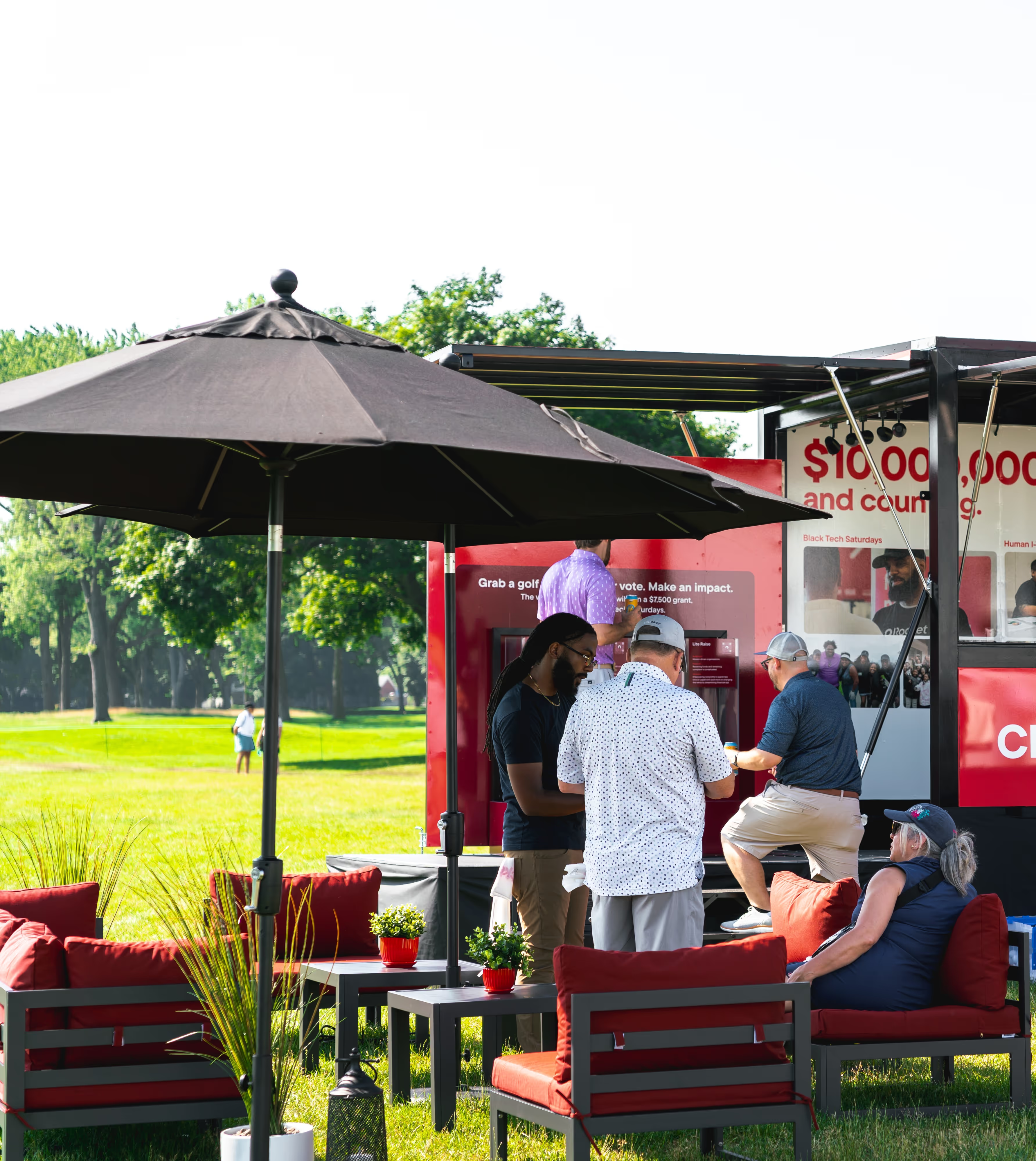
Interactive voting and survey collection through NFC lowers the barrier to participation. At the Rocket Classic 2025 activation, a voting kiosk let attendees select local startups to receive community grants from Rocket. Attendees tapped to cast a vote, got instant confirmation, and pulled up information on community initiatives. That kind of fast, tap-based voting drives higher participation than a manual system, while still capturing voter data for follow-up.
Educational stations benefit the same way. At the Rocket Classic, NFC tags let attendees tap for content on the company's community initiatives, impact metrics, and ways to get involved. The setup serves two audiences at once: attendees who want the quick overview, and the ones who want to dig into the detail.
Live events use this technology in a few common ways:
- Gamification and prize fulfillment: Consumers enter competitions, track scores, and receive prizes through digital delivery.
- Badge scanning and flow tracking: Credentials reveal which areas draw traffic and what path consumers take through the activation.
- Lead capture and automated follow-up: Systems capture contact information during engagement and trigger follow-up based on specific behaviors.
These applications record participation patterns and completion rates: data that shapes future activation design and closes the gap between a consumer's interest and the brand's response.
Technology Integration in Tours
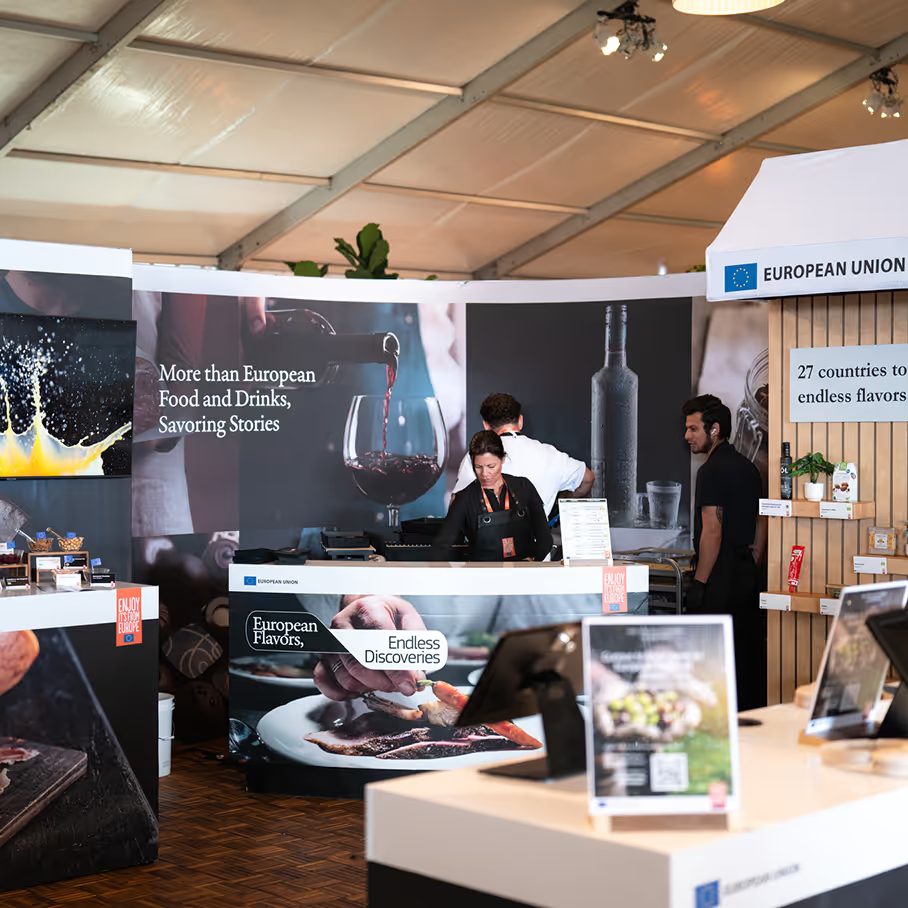
Location-specific content keeps a tour consistent while still adapting to local market differences. The EU Food & Wine Festivals tour visited five cities, each with a different demographic profile and set of consumer preferences. NFC let the activation deliver one core brand message while customizing the details (local product availability, city-specific events, market-relevant recipes) without changing the physical setup at each stop.
Product sampling verification and follow-up build accountability into mobile tour operations. Brand ambassadors log samples distributed, track inventory, and confirm sampling targets are met at each stop. Follow-up content triggers automatically based on which products a consumer tried and where.
Mobile tours get several insights from this data:
- Route planning data: Metrics show which markets generate the highest interaction rates and what times of day drive peak participation.
- Ambassador performance tracking: Systems record interactions per ambassador, engagement duration, and follow-up conversion rates.
- Cross-market comparison: Data shows how the same activation performs across different demographics and which markets are worth further investment.
- Consistent measurement: Standardized tracking creates comparable data even when the physical environment and consumer population differ from stop to stop.
These insights guide routing decisions for future tours and inform how a brand approaches new markets.
Measurement and Results
Direct engagement rates and dwell time at each station provide the baseline performance metrics: what percentage of attendees interact with each activation element, and how long they stay engaged with specific content or products.
Content access patterns reveal what actually interests consumers. The system tracks which information they request, what they download, and which topics get the most engagement, and that data shapes content for future activations.
Metrics captured through this technology:
- Lead quality and conversion tracking: Connects activation participation to business outcomes as leads move through the sales funnel.
- Geographic engagement variations: Identifies high-performing markets and reveals opportunities in underperforming regions.
- Time-stamped interaction data: Reveals when engagement peaks occur and what timing patterns emerge across demographics.
- Post-event follow-up response rates: Shows how well automated follow-up sequences triggered by these interactions perform.
Comparing response rates across activation elements shows which experiences drive the strongest ongoing engagement, giving brands a clear line from activation data to business outcomes.
Activate: Where Technology Meets Execution
Activate builds measurable brand connections through brand activations, mobile tours, and experience kits, combining planning with execution from initial concept through final measurement. The team builds systems that capture real-time data in brand activations, track engagement across mobile tour markets, and connect physical products to digital content in experience kits.
With a 75,000 sq. ft. facility and in-house logistics, we manage technology setup, testing, staff training, and data analysis directly. From tags built into signage to custom NFC products woven into branded merchandise, our production team handles the physical build behind the technology. Brands set the objectives; we handle the technical execution.
Planning an NFC activation for your next event? Connect with our team to discuss how data-driven experiences can deliver measurable results for your marketing goals.
Frequently Asked Questions
What services does Activate provide for experiential marketing?
Activate provides three core services: brand activations, mobile tours, and experience kits. Brand activations cover live events, pop-ups, sponsorships, and trade show experiences that create face-to-face consumer engagement. Mobile tours bring a brand to target markets across multiple cities with consistent execution and measurement. Experience kits, also called PR boxes, deliver a brand's story through custom-designed packages sent to consumers, influencers, or corporate recipients. Every service includes planning, creative development, production, staffing, logistics, and performance measurement.
Can Activate handle custom fabrication and specialized packaging?
Yes. The 75,000 sq. ft. facility includes in-house woodworking, truss and tailored aluminum structure modification, and specialty decorating such as laser etching, 3D printing, embossing, and stamping. For experience kits, the team builds custom packaging with 360-degree branding, magnetic closures, foam sculpts, and special effects that turn standard packaging into a distinct unboxing experience. In-house production gives Activate tighter quality control and more flexibility to tailor each project than outsourcing would. All kit packing happens on-site, which keeps attention to detail consistent across large-scale projects while still allowing variety within a single order.
What makes Activate different from other experiential marketing agencies?
Activate operates from a 75,000 sq. ft. facility in Metro Detroit with in-house fabrication, fulfillment, logistics, and warehousing. That gives more control over quality and customization than agencies that outsource production. The team handles everything from initial concept through final execution, so clients don't have to coordinate multiple vendors. Founded in 2013, Activate is a women-owned business with a team of more than 40. The focus stays on measurable results with specific KPIs rather than the experience alone, so clients get hard data that demonstrates return on investment.
What technical requirements are needed for NFC activations at events?
NFC-enabled events need compatible hardware (tags, an NFC reader, or a payment terminal), a backend system for data management, and reliable internet connectivity for real-time data capture.. Requirements scale with the activation: a simple setup might use passive tags that trigger content delivery, while a larger activation needs interactive systems with multiple points of engagement and real-time dashboards.
What metrics can brands measure through NFC-enabled activations?
Brands measure direct engagement rates (what percentage of attendees interact with each activation element), dwell time at specific stations, and content access patterns showing which information and topics draw the most interest. Lead quality metrics track how activation engagement influences purchase decisions and lifetime value. Geographic data identifies high-performing markets across mobile tours. Time-stamped interactions show when engagement peaks and what timing patterns emerge. Post-event follow-up response rates show how well automated sequences triggered by specific behaviors perform.
How do NFC-enabled activations improve lead quality compared to traditional methods?
Traditional lead capture (sign-up sheets, business card drops, raffles) collects contact information from passive attendees who may have limited interest. NFC systems capture data during active engagement, when a consumer chooses to tap for information, join an activity, or interact with a product. That choice itself signals real interest. The data goes beyond contact information to include interaction preferences, content accessed, products sampled, and engagement duration.