
How Eco-Friendly Experiential Design Transforms Brand Activations and Mobile Tours
Eco-friendly experiential design reduces waste while maintaining impact. For marketing decision-makers evaluating mobile tours and brand activations, sustainability now influences budget efficiency and brand perception alongside ethical responsibility. This approach addresses key concerns: How can we maximize asset value across multiple activations? What design choices reduce per-event costs? How do we align brand messaging with consumer expectations around environmental responsibility? Eco-friendly experiential design delivers engagement results while answering these questions.
What Eco-Friendly Experiential Design Means in Practice
Several core principles guide how eco-friendly experiential design works across mobile tours and brand activations:
- Modular structures: Reusable components reconfigure for different activations, creating infrastructure that serves multiple campaigns. These systems reduce material waste while extending the lifespan of each investment.
- Digital integration: Interactive screens replace printed signage that requires updating for each tour stop. QR codes direct consumers to digital content rather than printed collateral. These touchpoints maintain engagement while eliminating single-use materials.
- Transportation efficiency: Tour planning groups geographically close markets to reduce fuel consumption and transportation time. Vehicle selection depends on durability requirements and reuse potential across different brand campaigns.
- In-house fabrication: Production within a dedicated facility turns material remnants from one project into components for another. Quality control ensures structures meet durability standards for repeated deployment, reducing waste and per-activation costs.
Mobile Tours: Where Sustainability Meets Strategy
Mobile tours deliver sustainable experiential marketing. A single structure travels to multiple markets, reducing waste while improving cost efficiency.
Brands invest in infrastructure designed to serve ten, twenty, or fifty tour stops rather than building new installations for each market. These structures balance durability for repeated setup with visual impact that captures consumer attention. The challenge is maintaining structural integrity while creating experiences that feel fresh across dozens of deployments.
Modular components adapt to different venues. A mobile tour might visit urban plazas, suburban parking lots, and festival grounds within the same campaign. The core structure configures differently for each environment while maintaining brand consistency. Interchangeable elements—branded panels, product displays, interactive stations—update between tour legs without replacing the entire infrastructure.
Vehicle selection affects both transportation efficiency and reusability. Shipping containers offer durability and standard dimensions that simplify permitting and logistics. Custom trailers provide design flexibility but require maintenance investment. Vinyl wraps on containers allow graphic updates without structural changes, extending the asset's relevance across different marketing initiatives.
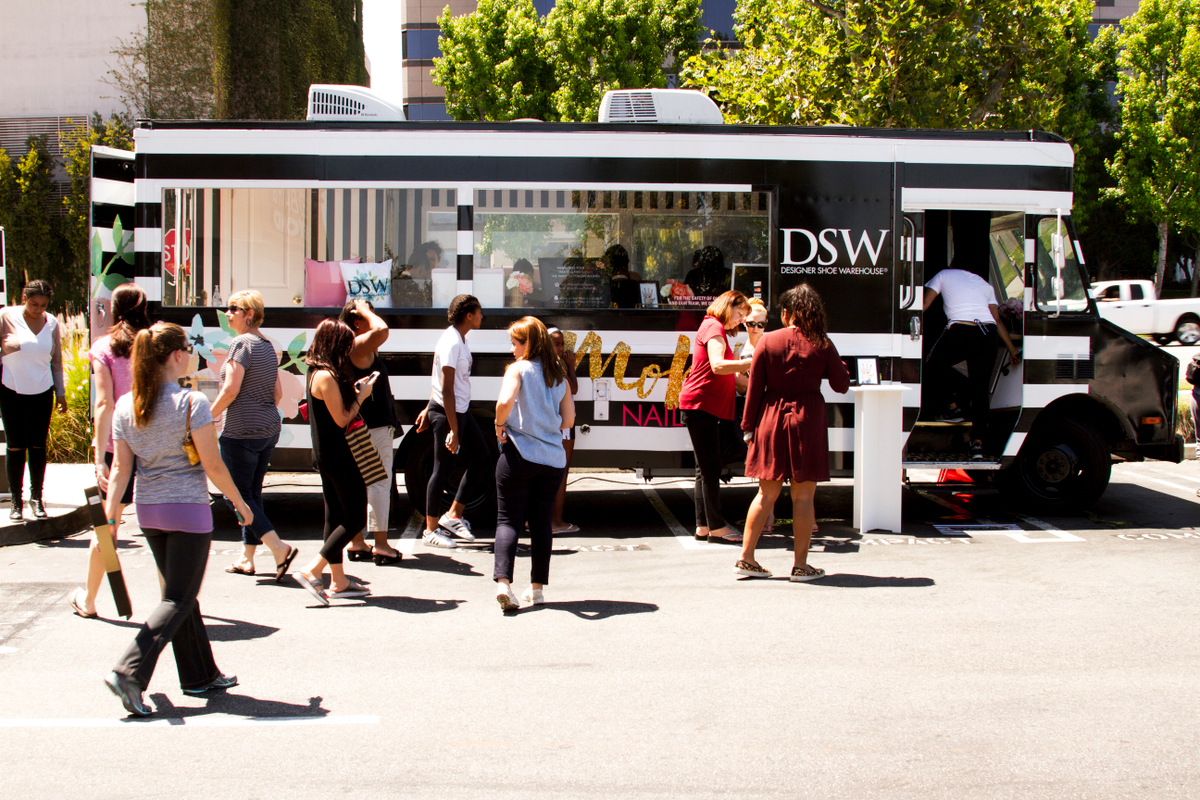
Activate executed DSW Designer Shoe Warehouse's vision for a mobile tour that showcased graphic design on reusable structures. The black and white striped pattern transformed a shipping container into a branded experience that traveled to multiple markets. Vinyl wraps on reusable infrastructure allowed the brand to update messaging for different campaigns while the core structure remained intact.
Multi-stop tours generate sustainability advantages:
- Eliminated waste: A single structure serving twenty markets eliminates the material waste of twenty individual builds
- Cost reduction: Per-market material costs drop while environmental impact decreases
- Brand consistency: The same infrastructure maintains campaign integrity across all markets
- Extended value: Asset tracking and maintenance between tour legs extends structure lifespan
- Future deployment: Post-tour storage enables redeployment for future campaigns or different brands
Brand Activations: Modular Design for Recurring Events
Brand activations use structures designed for reconfiguration and reuse. Annual events, seasonal activations, and recurring sponsorships create opportunities for infrastructure that serves multiple years.
Modular event structures let brands refresh activation design without complete rebuilds. Core components—framing systems, foundational structures, utility connections—remain consistent while surface elements and branded touchpoints update for each iteration. This maintains event freshness while reducing material consumption and production costs.
Digital elements replace printed materials. Interactive displays show product information. Photo experiences generate digital images that consumers share socially rather than printed takeaways. These touchpoints maintain engagement while eliminating single-use materials.
Pop-up activations use structures stored between deployments rather than built for each event. These components serve multiple activation cycles, spreading production investment across events while reducing the material footprint.
Activate: Sustainable Experiential Marketing with Results
Activate executes brand activations, mobile tours, and PR boxes that connect brands with their audiences. Our 75,000 square foot Metro Detroit facility provides turnkey capabilities including fabrication, fulfillment, and logistics. This infrastructure enables quality control and material optimization across every project phase.
We manage every detail from initial strategy through on-site operations. Our process integrates sustainability considerations from concept development through final recap, delivering activations that achieve measurable results. From modular structures that travel to dozens of markets to reusable event components, we execute brand visions with both immediate impact and long-term value.
Our team develops sustainable experiential programs that deliver measurable results for brands. Connect with us to discuss how eco-friendly experiential design can drive your marketing objectives.
Frequently Asked Questions
What is eco-friendly experiential design?
Eco-friendly experiential design creates brand activations, mobile tours, and events that reduce material waste while maintaining engagement. This approach prioritizes reusable structures, modular components, and digital integration over single-use builds. Key principles include durable materials that withstand repeated deployment, technology that replaces printed materials, and modular systems that reconfigure for different brand applications.
What's the difference between eco-friendly experiential design and traditional event marketing?
Traditional event marketing uses single-use structures built for specific activations and disposed of afterward. Eco-friendly experiential design uses reusable infrastructure that serves multiple campaigns. Traditional approaches rely on extensive printed materials while sustainable design incorporates digital touchpoints and interactive screens. Traditional marketing evaluates costs per event while sustainable design considers total cost of ownership across multiple activations.
How do you balance brand impact with environmental impact in mobile tour design?
Visual impact comes from graphic design, color application, and spatial layout rather than material volume. Bold patterns on shipping containers create brand presence without excessive material use. Digital integration provides interactive experiences that replace physical giveaways. Structures designed for reuse demonstrate brand commitment to sustainability, which becomes part of the brand story. Effective mobile tours achieve visual impact through design sophistication rather than material excess.
Can event structures be reconfigured for different brand activations?
Event structures built with modular design principles reconfigure for different brand activations through interchangeable components and flexible layouts. Core infrastructure like framing systems remains consistent while surface elements, branded touchpoints, and interactive stations update for each brand application. Vinyl graphics, interchangeable panels, and modular fixtures enable brand customization without replacing the entire structure. This maximizes asset utilization across multiple clients while providing each brand with a tailored experience.
What's the ROI difference between reusable and single-use event structures?
Single-use structures require full production investment for each event. Reusable structures have higher initial investment but serve multiple events or tour stops, dividing that cost across numerous deployments. A mobile tour structure serving twenty markets at $100,000 initial investment costs $5,000 per market, compared to $15,000-$25,000 for individual builds in each location. The ROI advantage compounds over time as the same assets serve additional campaigns.
How long do mobile tour structures typically last before needing replacement?
Well-constructed structures using durable materials typically serve three to five years of regular deployment, completing multiple tour campaigns during that period. Component-level maintenance extends lifespan—replacing worn panels or updating graphics while preserving the core infrastructure. Storage between deployments in climate-controlled facilities protects assets from deterioration. Treating these structures as infrastructure investments requiring ongoing maintenance maximizes useful life and return on investment.